
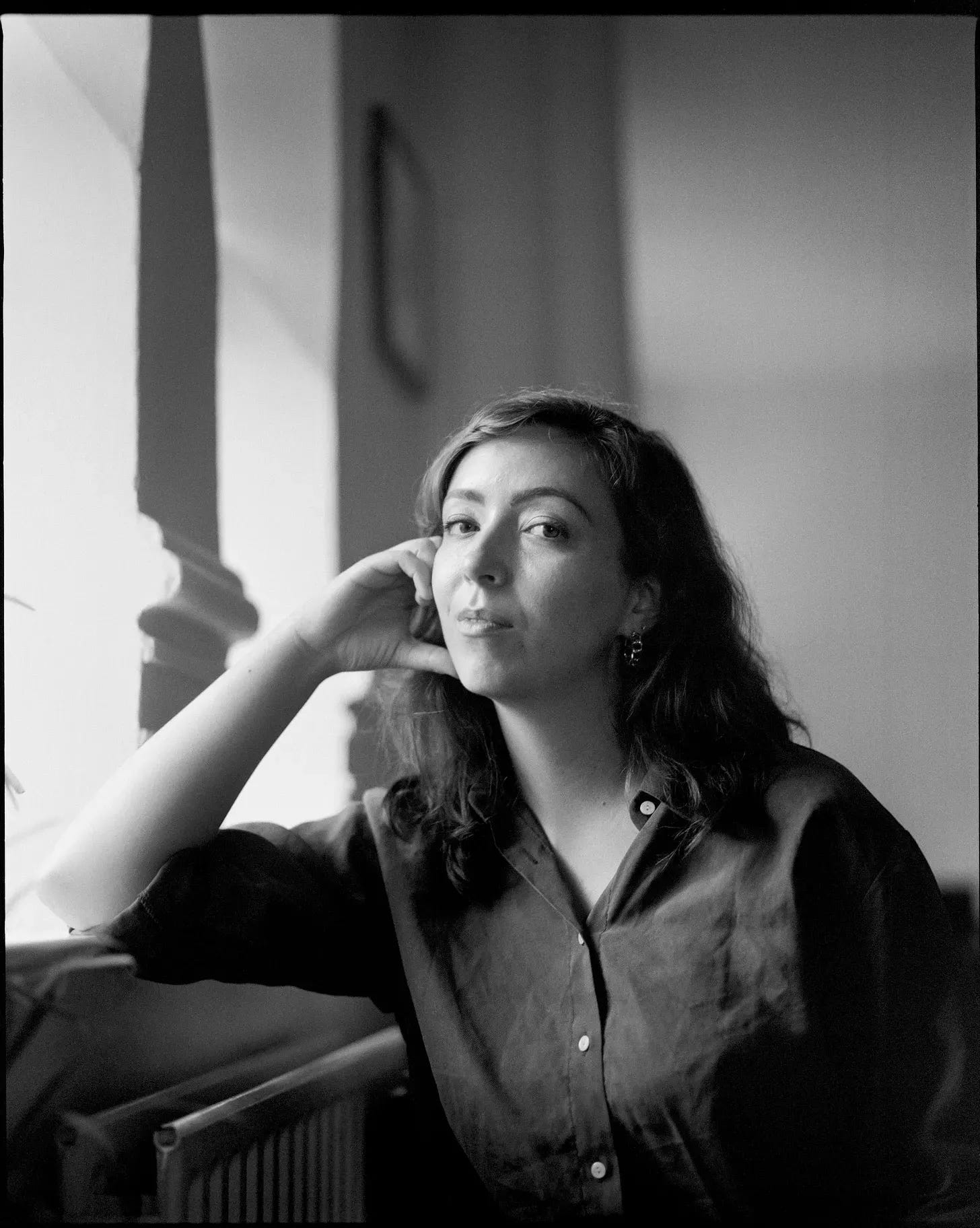
What can you tell us about this poem, “Divining Rod as Straight Culture”?
This poem was written during my first year as part of Barbican Young Poets when we were invited to respond to Citra Sasmita’s sumptuous exhibition Into Eternal Land at the Curve Gallery. At that same time, President Trump issued the Immediate Expansion of American Timber Production. So much of Sasmita’s work centered on roots and wombs while I felt like much of my own upbringing was being literally uprooted. Growing up openly queer in the suburbs of the American Midwest brought its own set of challenges; state parks and woodland walks were places where I felt protected, where I could exist and breathe. Many of these lines in the poem harken back to my own relationship with nature and folklore (afternoons spent inside a conclave of pine trees; throwing apple rinds behind my back to find the first letter of my future spouse’s name). All of these images and memories began to braid themselves quite naturally for me.
What poets and poems are you in dialogue with?
I work as an archivist for a visual and concrete poetry collector, so a lot of my time is spent cataloguing communication between poets. As for myself, Daniel Grimston is a poet and playwright who I have had the fortune to engage in many a caffeinated dialogue with. Their work is so rooted in place, whereas I am writing to make sense of where I come from. Angbeen Abbas and the whole crew at Page of Wands have made a radical free space for London-based writers to congregate (on that note, save SET Social!). I’m currently collaborating with poets Jasmin Allenspach, Francis-Xavier Mukiibi, Tusshara Nalakumar Srilatha, and Pallas Yiu on a polyphonic piece which remains a humbling act to create work together. And a special shoutout to Glasgow-based Bluey Little, whose shared love of postcards led to us co-coordinating a mail art exquisite corpse-style poetry project with fifteen other poets at the Barbican Centre. Being in active dialogue with poets, be that through archiving or collaboration, remains crucial to my practice and the upholding belief that poetry exists as an ecosystem.
Do you write in other forms? (Prose etc) how do you toggle between them?
Oh my, so I started out writing across theatre, television, and interactive media and turned to prose at some point during the Covid lockdowns. Poetry became a more central practice while waiting for the dust to settle on early novel drafts. Writing poetry has nurtured the editing process for prose on a sentence-by-sentence level. Performing poetry brings me back to play readings and listening and learning from an audience. I don’t know if I am consciously toggling between forms, but I am heavily informed by them and value the varied experience.
What’s your favourite text about the sea? Or beaches?
Iris Murdoch’s The Sea, The Sea. An old friend with strange appetites, one I am waiting to revisit.