

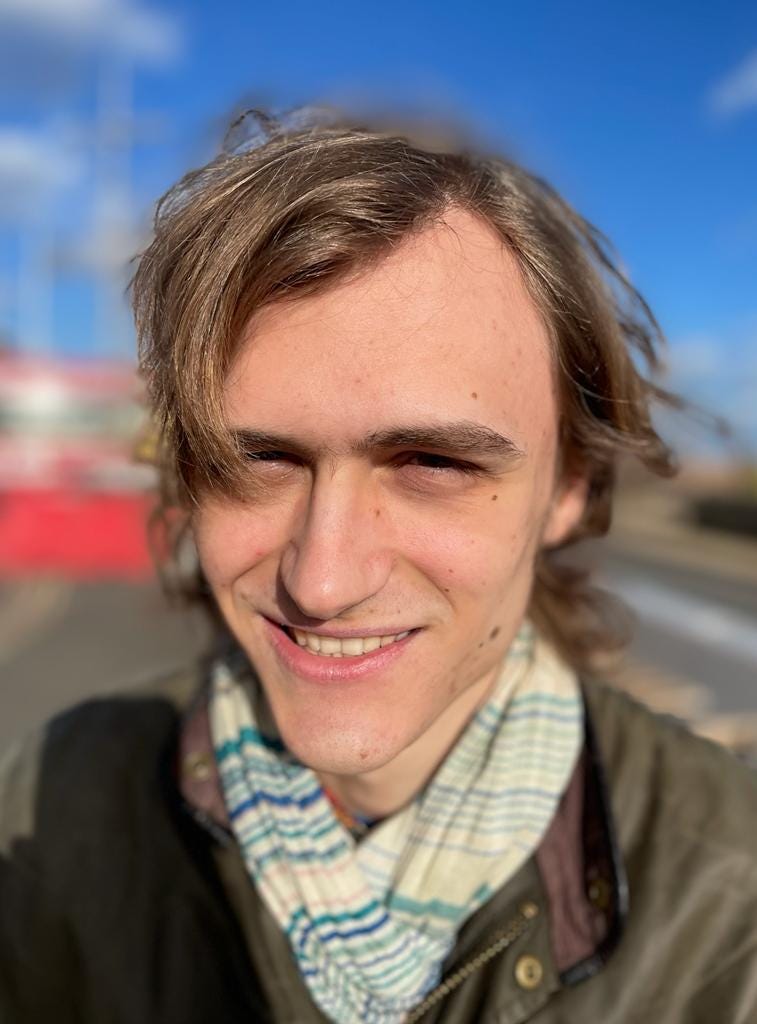
What can you tell us about this poem?
“Pontifical” grew out of my semester studying in Rio de Janeiro, Brazil, for my undergraduate degree. I was initially a little nervous at the idea of going to a so-called Catholic university as a practising bisexual, but my worries were unfounded and no one there had any issue with me! I was slightly taken aback to end up dating another man for the first time while I was studying there — part of a repeated pattern in my life where I seem to end up making queerer choices the more religious an environment I find myself in. The relationship didn’t last, but it taught me a lot about myself and I wanted to commemorate it in poetry.
What poets and poems are you in dialogue with?
Nina Mingya Powles is perhaps my favourite contemporary poet: I love the range of styles and forms she uses in her poetry and the way she uses all five senses to create vivid images. A lot of my poetry is autobiographical as well, so I admire the way she takes the very specific and personal and turns it into a mirror held up to the world. Oliver James Lomax’s collection Burial of the Cameo stunned me when I read it recently, and I’d love to be able to use metaphor the way he does – deft comparisons between objects and experiences that open up limitless imagery in the reader’s mind. Finally the two poets I have learned the most from are Glyn Maxwell, through his masterpiece On Poetry, and Kym Deyn, through ten years of friendship, collaboration and wisdom.
What poem do you wish you’d written?
The Two-headed Calf by Laura Gilpin. I often visited the two-headed calf at the Bowes Museum as a teenager and wanted to write something to commemorate it, only to read Gilpin’s poem and realise that my own attempt would have been about ten times as long with a tenth of the impact. I hope I can sometimes achieve such clarity and warmth in my own poetry.
Do you write in other forms? How do you toggle between them?
I’ve only really thought of myself as a poet for about four or five years, and before that I exclusively wrote short stories. This led to my earlier poems being rather prosaic when I started to branch out into poetry, but I feel I write it with a little more mystery these days. I’ve found poetry more freeing in recent years: creating a mood and sketching a portrait or telling a brief story with a few well-chosen images seems to come to me more naturally than telling an extended narrative. I also write the occasional script, during which I have to work quite hard to keep my dialogue naturalistic and not let it get too flowery! I can easily imagine working in all three mediums indefinitely – they all bring out different sides of me which I value.
What’s your favourite text about the sea? Or beaches?
I loved the historian Alistair Moffat’s latest book “The North Sea: Along the Edge of Britain”, which explores Britain’s relationship with what we used to think of as “our” sea and how it’s shaped the island’s history. Moffat writes about the big events like Roman and Viking invasions and Lancaster bombers flying to Berlin, but also about English seaside traditions and the breeding habits of gannets. I live in Newcastle upon Tyne and visit the coast regularly, and it moves me tremendously to think of how many have crossed that sea in both directions, to fight, to find new homes, and to fish.